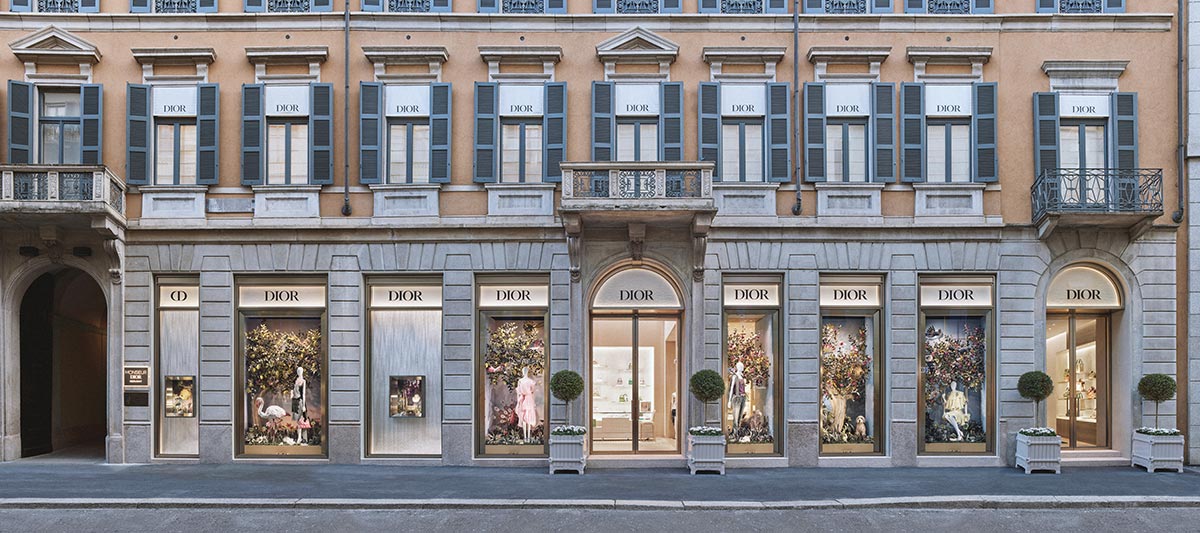
It is an ancient disposition of Milan, that of adopting its foreigners with such thoroughness that they end up inscribing themselves among its natives. Stendhal desired that his tombstone in Montmartre should bear the words Arrigo Beyle, Milanese, and the city seems to exercise the same discreet enchantment upon whoever lingers long enough beneath its porticoes. Milan entrusts its splendour to the interior, to that hortus conclusus which the medieval imagination conceived as a guarded paradise and which survives today behind austere façades, in courtyards granted only to the patient and the invited. Within this grammar of discretion lies the key to reading the House that Dior has just inaugurated on Via Monte Napoleone, inside a neoclassical palazzo of the late seventeenth century whose rusticated stone and slate-grey shutters preserve the composure of the old Milanese families, while its windows, for once, consent to confession.
Behind the shuttered windows, a courtyard exhales
its slow breath of moss and weathered marble.
And what they confess is a garden. Composed entirely of fabric remnants rescued from Dior’s ateliers, the displays unfold beneath lemon trees and wisteria, where mannequins attired in Jonathan Anderson’s looks stand among flowerbeds under the vigilant gaze of a flamingo, homage to the rose-coloured birds that still wander the gardens of Villa Invernizzi, a short stroll away, to the perpetual enchantment of passers-by pressed against its railings. Before those lemon trees one inevitably returns to Goethe and to Mignon’s song, Kennst du das Land, wo die Zitronen blühn?, the question that for more than two centuries has drawn northern souls towards Italy, and which a French Maison now answers with scissors and offcuts, transfiguring the leftovers of couture into an Arcadia, in a gesture whose ethical weight resides precisely in its lightness. Victoire de Castellane’s high jewellery glints beneath a murmuring beehive, and the bestiary follows the visitor across the threshold, where an owl presides over the leather goods with the solemnity of an academician.
Lemons ripen on branches of silk,
where a flamingo folds its blush of silence.
The garden, after all, was Christian Dior’s first atelier. As a boy in Granville he whiled away his afternoons in his mother’s garden, committing to memory the names and descriptions of flowers from the seed catalogues, and the maxim so often ascribed to him, that after women flowers are the most divine of creations, reads here as a veritable blueprint. Peter Marino has raised the three storeys around this conviction, allowing light to flood through every window and opening terraces and inner courtyards where Peter Wirtz has cultivated living walls that seem to breathe in unison with the city. Around a glass atrium, the women’s and men’s universes face one another like the two wings of a single dwelling, and the pale materials, together with the mouldings that on the second floor evoke a Parisian apartment, carry the memory of 30 Montaigne with the lightness of a traveller who has learnt to pack only the essential.
In a child’s cupped hands the flowers keep their Latin names,
soft as chalk, already dreaming of becoming a gown.
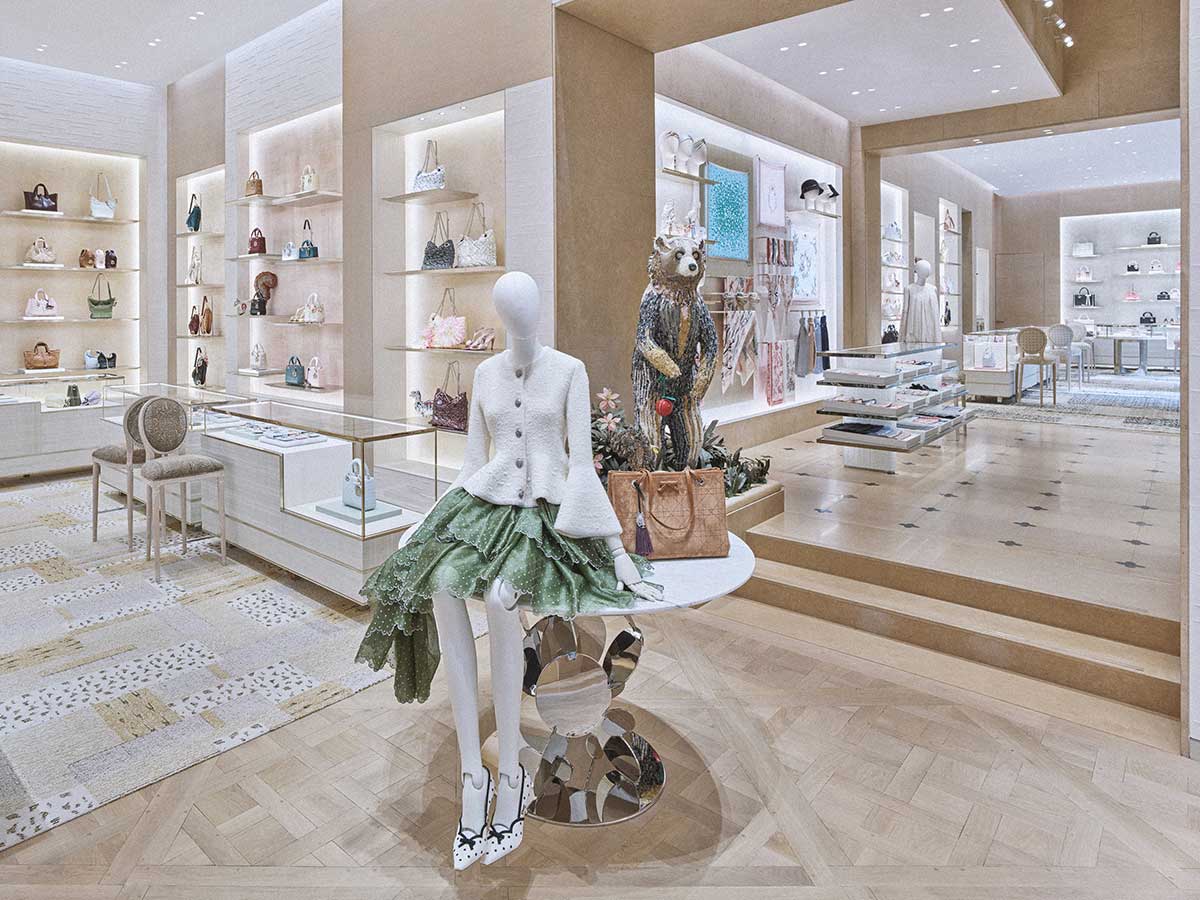
Herein resides the most eloquent intuition of the project. Zola, in Au Bonheur des Dames, described the great Parisian emporium as a cathedral of modern commerce, and for well over a century luxury retail has pursued that monumental ambition with fervent zeal. The House of Milan elects instead the more intimate register of the dwelling, where private salons and a hushed beauty room invite the visitor to linger, and where true luxury, in an age that consumes its own desires at the speed of a screen, becomes the time one is permitted to squander.
The afternoon pours itself slowly into amber,
and the hours, at last, learn the grace of lingering.
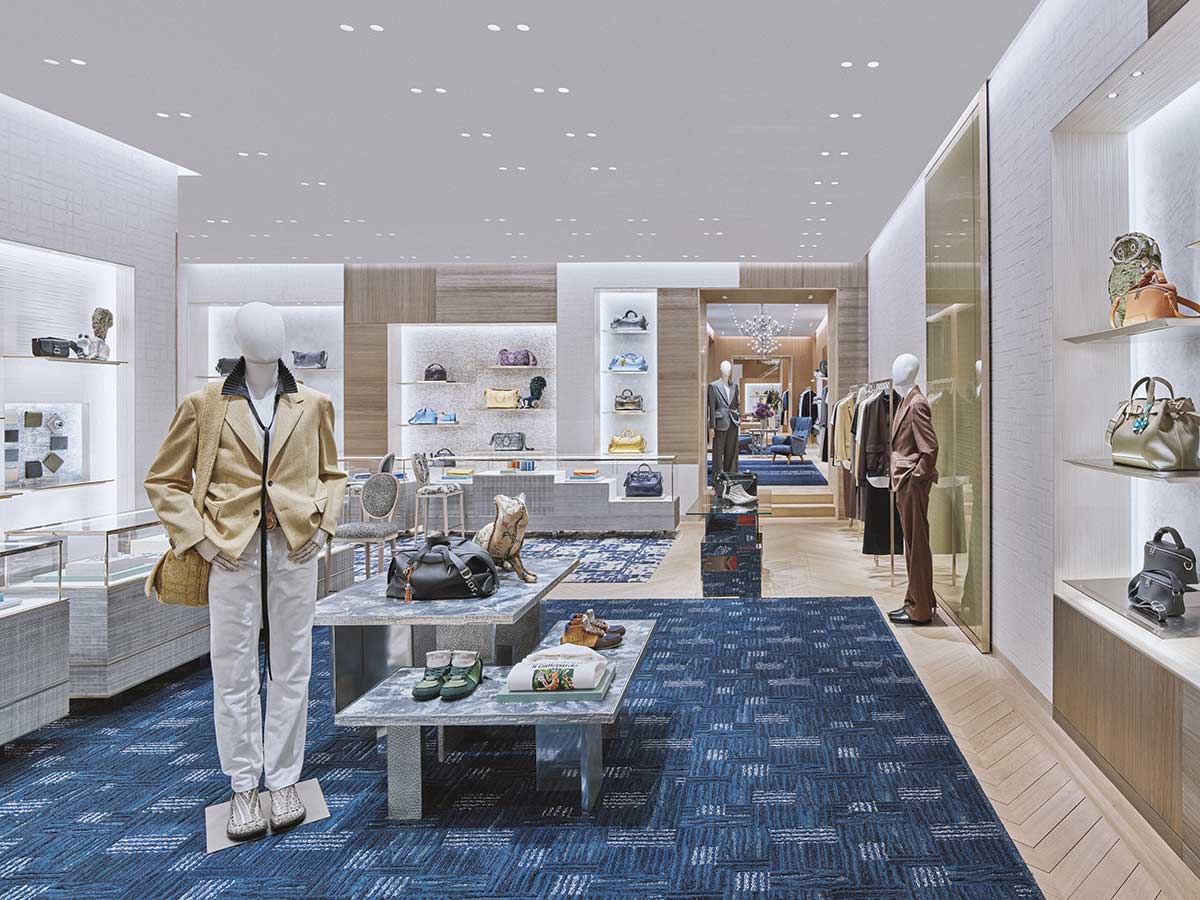
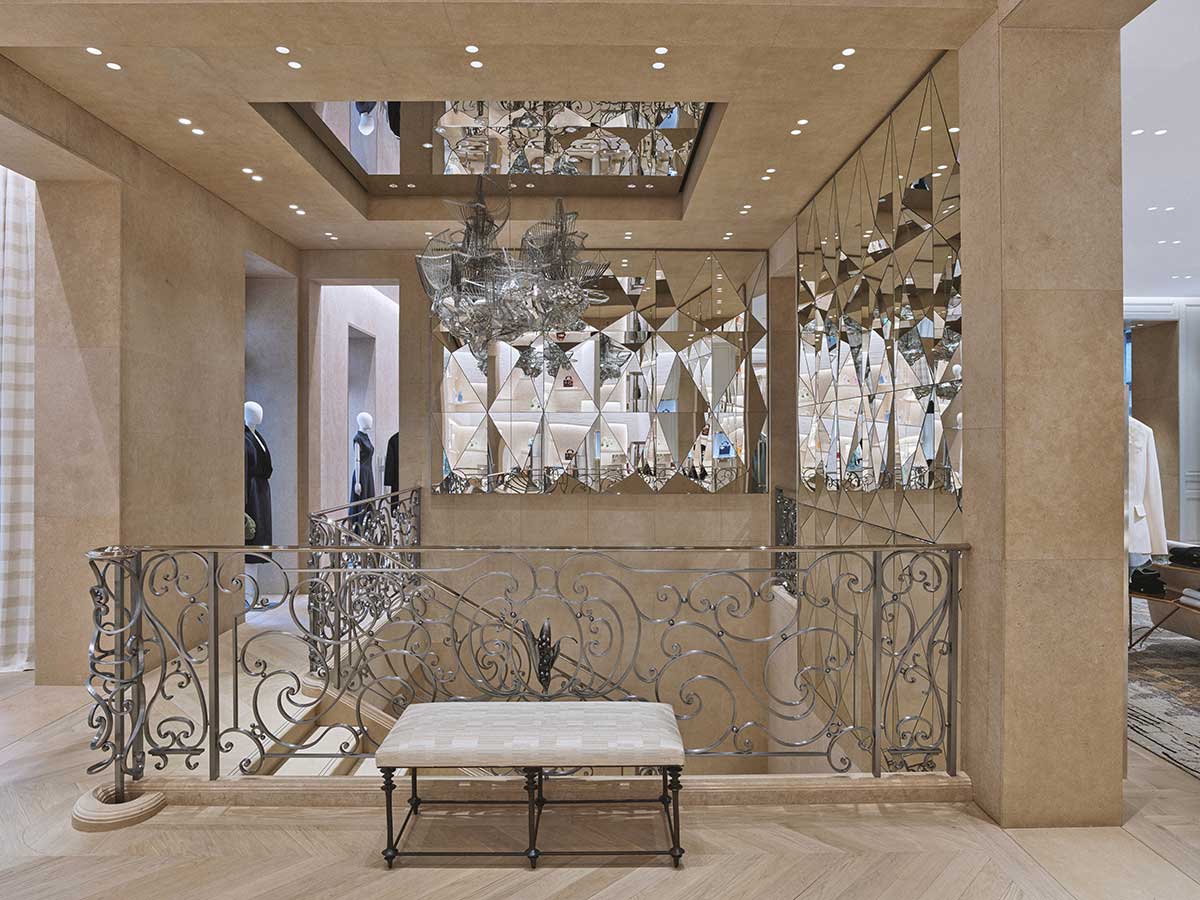
Two staircases ascend, each endowed with its own temperament. On the women’s side, stone and wrought-iron arabesques escort works by Lee Bul and Claudia Wieser, while on the men’s side a wooden wall arrayed with white toiles climbs through three floors in homage to the haute couture ateliers, inviting the visitor to linger far longer than decorum would advise and to read those pale cotton phantoms as one reads the drafts of a novel still in the making. Before he was a couturier, Dior had been a gallerist, championing Dalí in the Paris of the early Thirties, and his heirs have preserved that connoisseur’s eye. A portrait of Monsieur Dior by Michelangelo Pistoletto keeps watch over the rooms, alongside Claude Lalanne’s Ginkgo Bench and shelving by Vittorio Introini, so that art inhabits the house as a member of the family, sharing its meals and its silences.
Cotton ghosts climb the walls in ivory hush,
pale as a bride on the eve of her first stitch.
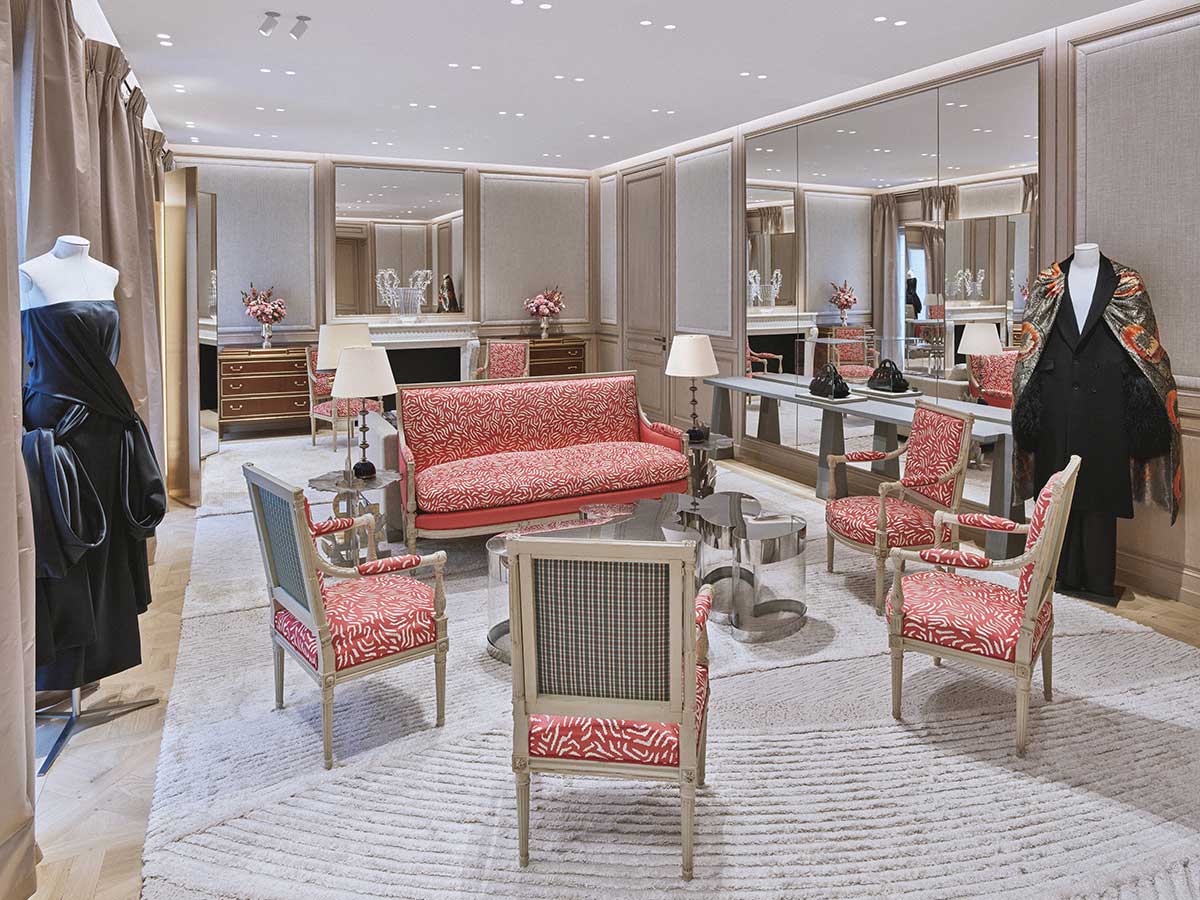
For the inauguration, the Maison has summoned a cherished ghost. The leopard print that Dior dedicated to Mizza Bricard, the muse who wore her panther spots and her bracelets as other women wear a perfume, resurfaces on the Dior Bow pumps and on the charms suspended from the Lady Dior, now also offered in small and mini proportions in shades of chalk and honey. Bricard would surely have approved of a city where a hint of the feral is best carried with impeccable posture.
A leopard dozes on a satin bow,
dreaming of Paris in the honeyed dusk.
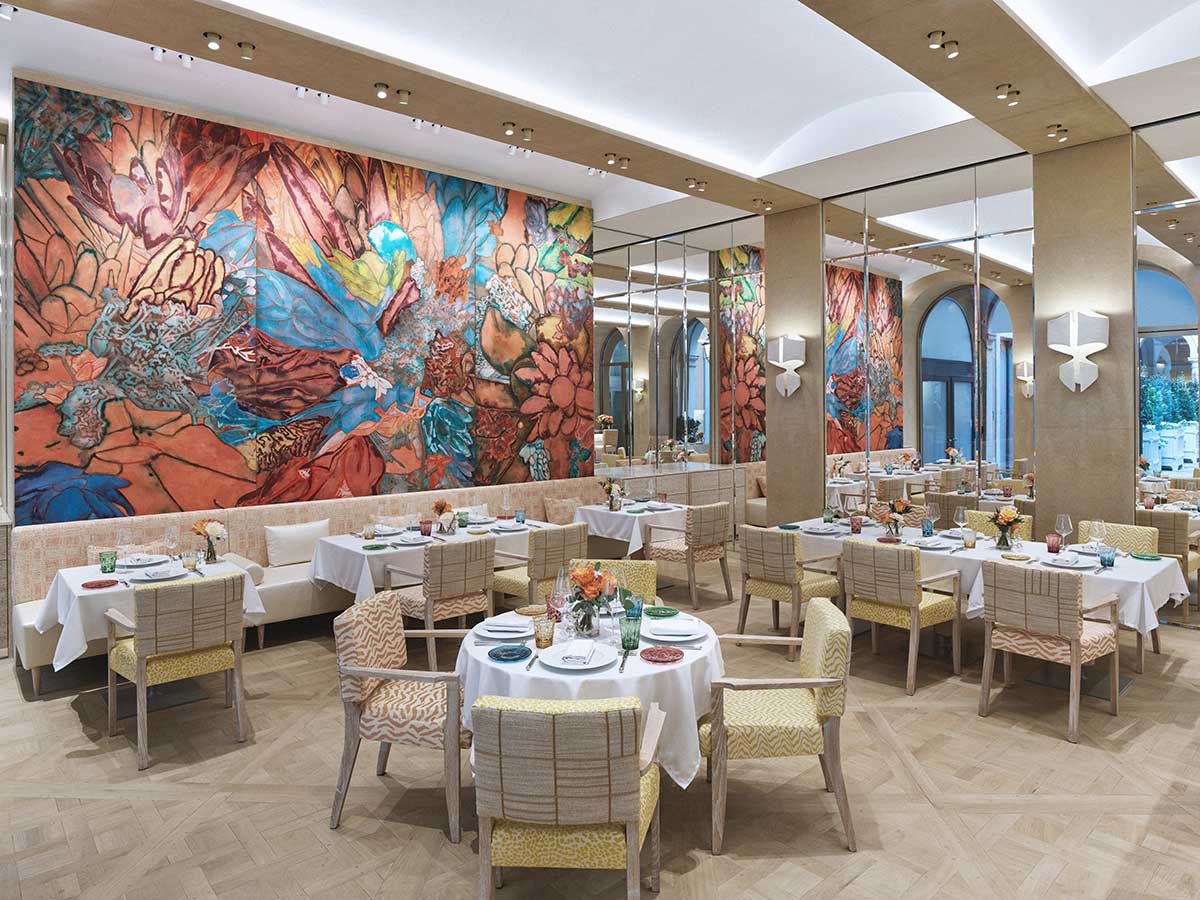
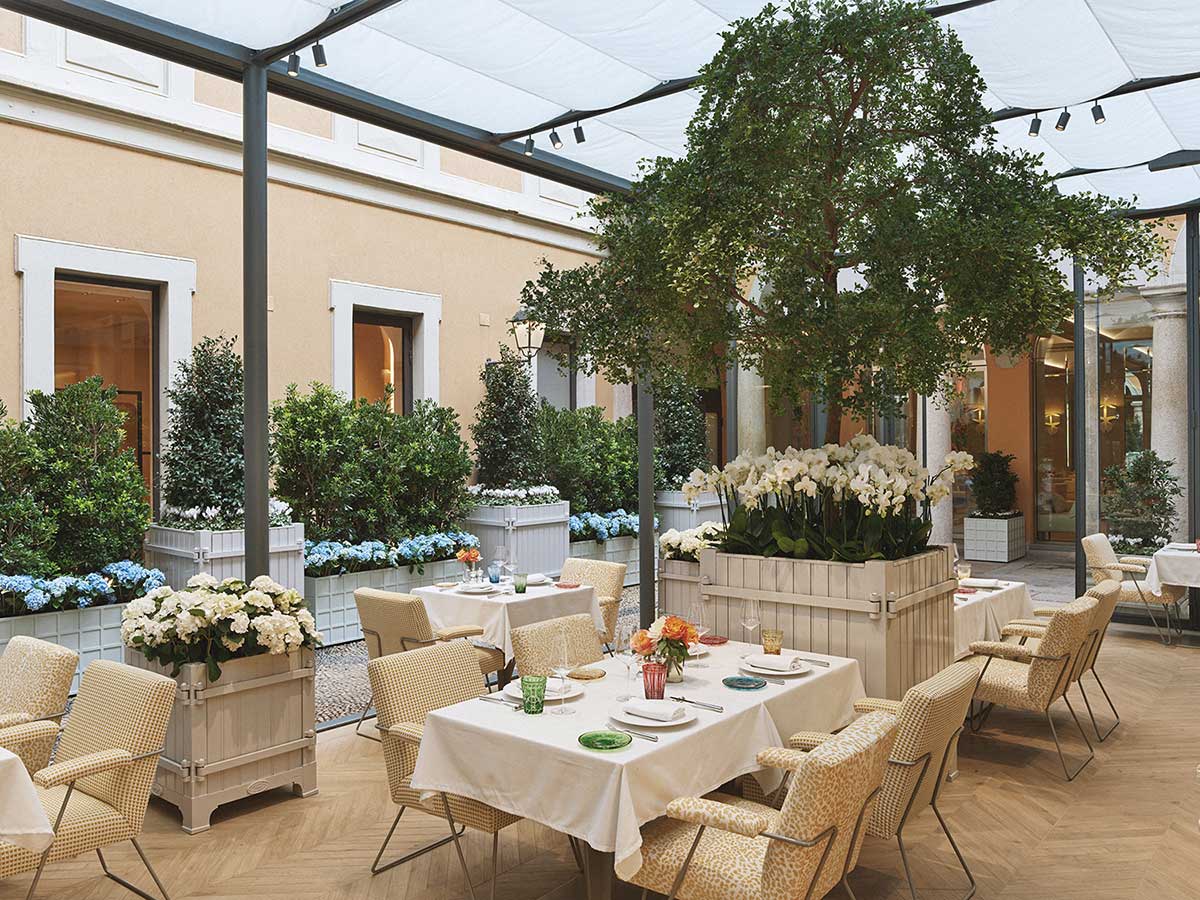
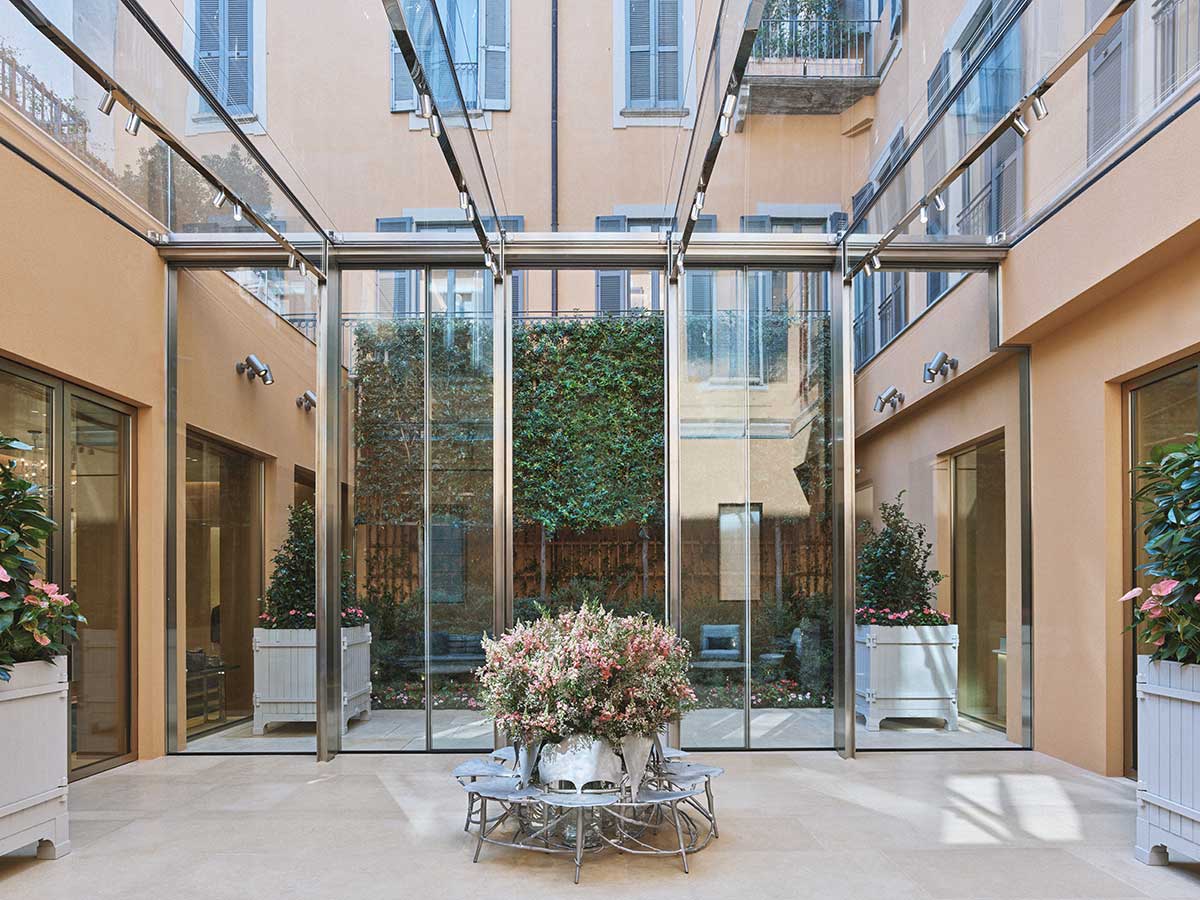
Then comes the table, which in Milan remains the most refined form of conversation. The Monsieur Dior restaurant, likewise conceived by Peter Marino, gives onto an inner courtyard where arcades enclose the boxwood beneath a glass roof, while Versailles parquet and a floral canvas by Francesco Clemente soften every sound into a murmur. Enrico Bartolini, Tuscan by birth and Milanese by adoption, and the most Michelin-starred chef in Italy, has composed a menu that borrows from couture the principle of layering, so that his knife-cut Piedmontese beef unfurls like a corolla and his veal with Swiss chard and raspberries arrives cloaked in a ruby chocolate emulsion with all the audacity of an evening gown. His signature risotto of beetroot and Gorgonzola pays tribute to the Oltrepò Pavese that welcomed him more than twenty years ago, and the Sale e Pepe soufflé toys with a classic as a gifted stylist toys with a white shirt. Bartolini, too, is one of Milan’s adopted sons, and his cuisine seems to seal the thesis of the entire house, that belonging is an art cultivated over time.
Under the glass, the boxwood cradles the light
like a green chalice brimming with afternoon.
The evening dissolves into the Grand Soir Chocolat, an airy cocoa composition crowned with 30 Montaigne beneath a star-strewn sky, a façade rendered in chocolate capable of stirring the soul more than many a monument. Along Via Monte Napoleone, where the illuminated windows glow like small chapels after closing time, one is left to reflect that the greatness of a house resides in its capacity to be adopted, to arrive from elsewhere and be claimed by a city as one of its own. Milan has always bestowed this privilege upon the most attentive of its guests, turning a French novelist into a citizen and, it would now appear, a Parisian couturier into a neighbour. Should this address one day require an epitaph, the most lapidary of all could be borrowed from an old friend of the city. Christian Dior, Milanese.